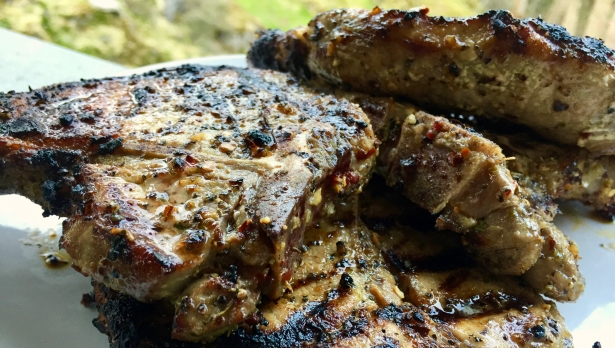
Team Temple grills these every week. All year. I don’t exaggerate when I say they are the best steaks I’ve ever had. You can use this method for beefsteaks, but why would you? Porksteaks are way more flavourful. It is a sad day indeed when we run out and can’t get more until the farmstand opens on Saturdays. We prefer nice thick t-bone chops with a good mix of white and dark meat and a nice fat-cap (it’ll crisp off).
There are three keys to porkchop nirvanna: DRY, OIL, REST.
1: Marinate
First thing I do is marinate them with a few splashes of Bragg soy/aminos. I don’t marinate long, just enough to get a bit of umami seeping in. Probably if I did longer, they’d be even better. I take the chops straight out of the fridge for this. I don’t bother letting them pre-warm to room temp. I think this helps keep more of the thick chops rare/med-rare while the outside gets the right amount of crisp/char.
2: Dry
Key number one to crispy chops on the BBQ is to dry them off as well as you can. The best way to do this is with a couple pieces of paper towel. If I use the wettest towels on the chops first, working your way to the new, I can get the total down to one small ‘select-a-size’ per chop. Not too wasteful, and the dryness makes a HUGE difference.
3: Salt
Lay the chops in a (dry!) bowl and sprinkle salt fairly liberally on both sides. Koshering salt works best because you can get more coverage. Don’t be shy with it, most of it will drip off, but it’ll really make a difference in the flavour and crispiness.
4: Season
Make up the rub. I just sprinkle some flavours that work well with the chops. Through much experimentation, I’m currently doing the following. Amounts are guesses based on the relative proportions for four large chops. You almost can’t have too much rub, because it will slough-off with the excess oil.
- 2tsp black pepper
- 1 tbsp chili flakes (for citrus high-notes, not spice)
- 1/2 tsp fennel seeds (roughly crushed)
- 1tsp onion powder
- 1/4tsp granulated garlic
- 1/2tsp aleppo pepper (just a touch for the earthiness, not spice)
- 1tbsp clubhouse greek salad seasoning
5: Oil
Key number two is to pour on lots of olive oil, probably half-a cup. Then mix the chops, seasoning, and oil together in the bowl. You want enough oil that they’re well slathered in it, with a bit of standing oil in the bottom of the bowl.
(Aside: Costco’s Kirkland-brand organic olive oil is FANTASTIC, the best tasting we’ve found for under gold-bullion pricing. It’s quite inexpensive, but amazingly good for raw applications, never woody. It’s what we use for cooking too.)
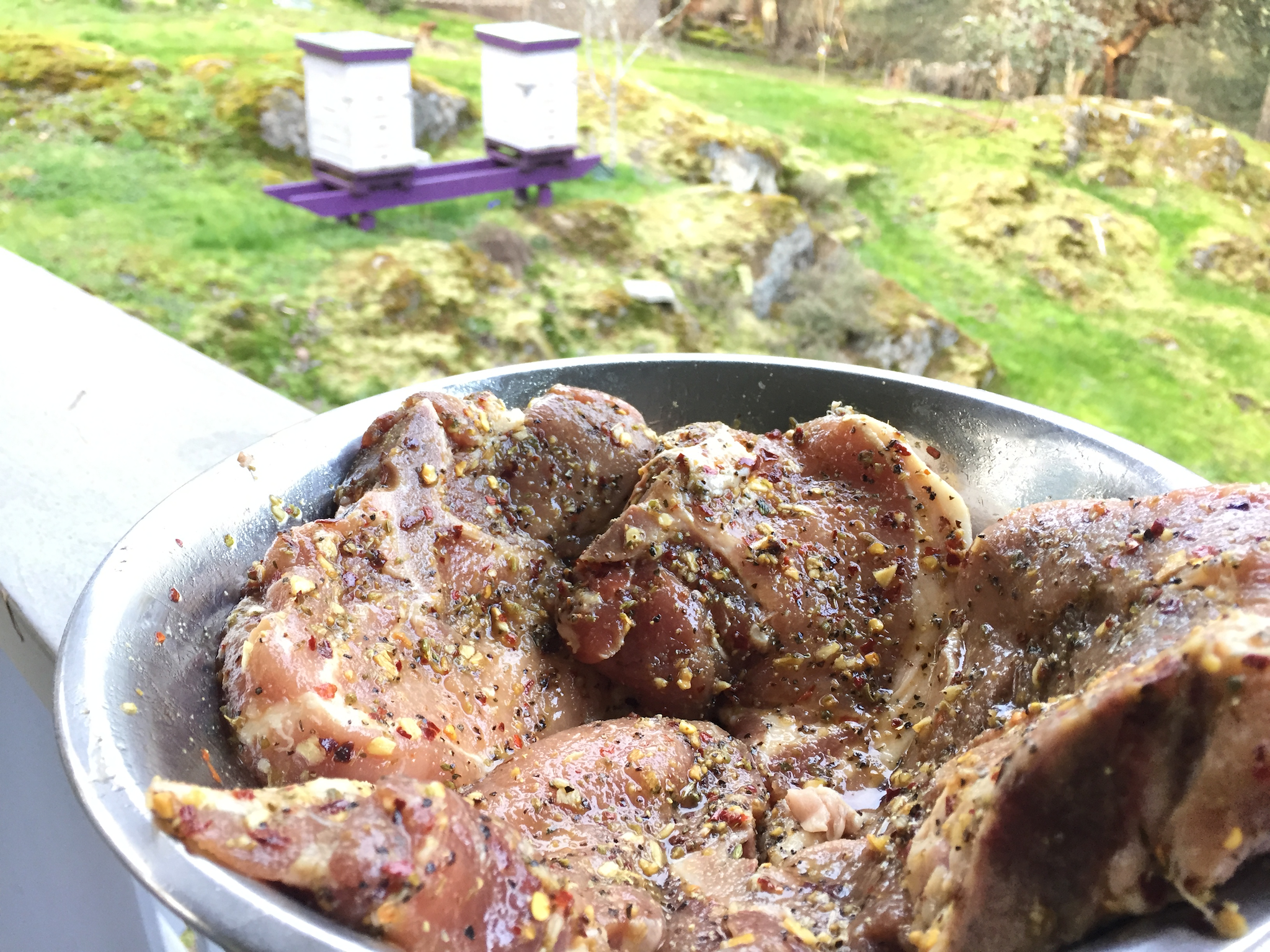
Slathered in oil is the best way to get a good sear on a propane barbecue.
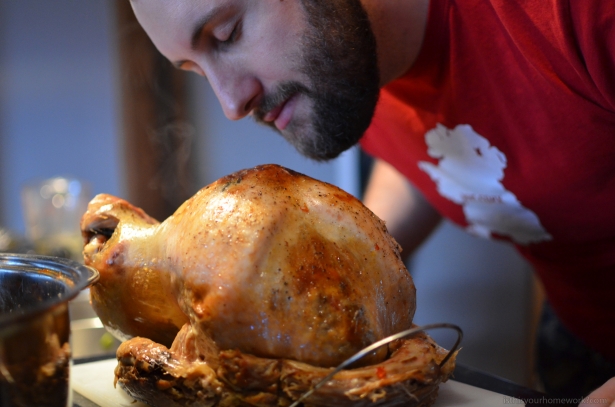
Turkey, turkey, turkey! Here it is, my mother’s amazing turkey dinner recipe, straight from the source [with my notes added in brackets].
I know that everybody’s partial to their mother’s cooking, but my mom’s turkey dinner is always outstanding! It’s her secret weapon for getting me over to the Island to visit. I’m a horrible son. (Sorry Mom!)
It’s not as specific as a cook-book recipe, but it doesn’t need to be. Anybody with a cook’s soul should breeze through it (chef-ery not required). Post your questions, and I’ll answer below. (My Mom may even too!)
Stuffing
- italian bread, extra long sliced loaf [D'Italiano works great, so do more squirrely breads]
- onion
- garlic
- celery
- italian sausage [Costco hot italian is outstandingly good italian sausage for any recipe!]
- mushrooms [I use white, but you can use whatever floats your boat]
- red pepper
- eggs
- salt
- pepper
- sage
- poultry seasoning
- butter
- olive oil
Make sure that you freeze the loaf of bread ahead of time so that it is easy to cut into cubes without it getting squishy.
Put some olive oil and butter in a large saute pan. If your italian sausage is in casing, remove and crumble into pan as many to taste, say 5 or 6 for a full loaf of bread [I use 4 or 5 of the big Costco sausages, about 600-700g]. Add onions and brown along with sausage.
In the meantime finely chop one or two celery stalks, loads of garlic, and as many mushrooms as you like [I use lots, you can't have too many!].
When the sausage is browned, turn down heat and add the celery, garlic, mushrooms, some more olive oil and too much butter for anyones good. I use lots of butter as it gives a nice flavour [It's turkey dinner, leave your food-conscience at the door!]. Add quite a lot of sage – again to taste – bearing in mind it will diffuse through the bread so if it seems too strong, it probably wont be. I’d say about 2 tablespoons at least, maybe more. Add about the same, or a little less in poultry seasoning. Grind in some pepper, but don’t use too much salt as the butter is salty. Also at this time add water to the pan, enough to make it all quite moist but not soupy.

He prepared the explosives with slight care, quickly, casually, the ritual well-practiced, components proportioned more or less precisely, burner tuned just-so to an unmarked setting, the steel lid lowered for even heating and explosive containment.
Sirens sang, foreboding shrieks and squawks and shearing sounds, as the vessel was shaken and slid across the element, stirring untouched its contents. Intermittently the concoctor ceased his agitation and crooked an expert ear to the silence, listening for sizzling, steady but not slow, energetic but not angry. It mustn’t burn. Burning meant acrid smoke, accusatory smoke, overpoweringly aromatic smoke, smoking evidence that lingered, alerted the neighbours, testified to his activities, testified to his inexpertise.
An explosion surely overdue, his doubts began to mount. Was it too hot? Not hot enough? Was this batch going to explode? *pop* The first explosion always a surprise, always a relief. *pop-pop-pop* The explosions came faster, faster still. The tin-can rat-a-tat-tat of the popping startled his senses, stimulating salivation before sent was detected.
Still shaking, sliding, stirring the pot, he watched, trance-like, the stochastic explosions sending kernels careening, chaotically clanging and caroming off the pot with each pop, pop, pop.
Eyes drying and mouth watering, he stood mesmerized by the turmoil. Blasted blossoms burst like frozen fireballs, each concussion showering the seething mass with corn-husk shrapnel, triggering secondary and tertiary explosions as ticking time-bombs tumbled.
At last the cacophonous barrage began to abate. But not the stirring, shaking, sliding. He knew the risk of burning was highest now, knew that explosive packages had to be sifted toward the heat, had to be detonated before the now-dry pan overheated.
Three seconds. Three seconds without a pop was all that could be afforded. One—*pop* The clock reset. One…*pop* Reset. One… two…*pop* Reset again. One… two…*pop* Too long, three seconds was too long this time. One… two… —burning, it was going to burn— three! He doused the burner, threw back the lid, and dumped the steaming contents into the waiting container.
Perfect popcorn.
Read the rest of this entry »
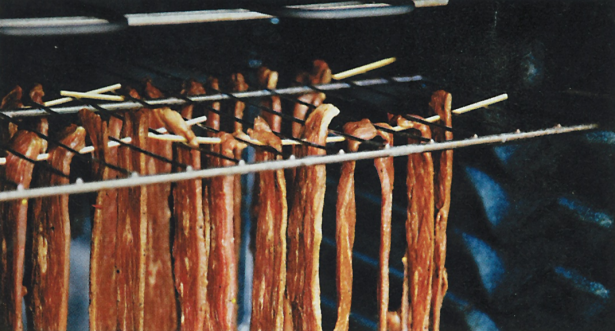
I wanted to share this amazingly easy, healthy, and unbelievably delicious homemade beef jerky recipe I made the other day. MrsTemple found the recipe in Clean Eating magazine. Despite its suspiciously ‘health-conscious’ approach, the mag is surprisingly full of delicious recipes. I’d recommend it, as it is for food-lovers, not weight-losers.
Spicy Oven-Dried Beef Jerky
Makes 12 oz (about 50 pieces). Hands-on time: 1 hour. Total time: 10 hours.
Nutrients per serving (2 large strips): Calories: 27, Total Fat: 1 g, Sat. Fat: 0 g, Carbs: 1 g, Fiber:0 g, Sugars: 1 g, Protein: 4g. Sodium: 92 mg, Cholesterol: 8 mg
Ingredients
• 2 lb eye of round beef roast, flank steak or London broil, trimmed of visible fat
• 2/3 cup low-sodium soy sauce
• 2/3 cup 1/6 cup low-sodium Worcestershire sauce (1:1 worcestershire to soy is way too much, use 1/4 of the amount of low-sodium soy, and it’s delicious.)
• 1 tbsp raw honey (Rather than honey, I used the same amount of brown sugar.)
• 2 tsp fresh ground black pepper
• 1 tsp onion powder
• 1 tsp garlic powder
• 1 tsp red pepper flakes
• 1 tsp smoked paprika or liquid smoke, optional (I used smoked paprika)
Instructions
ONE: If using a large roast or steak, slice beef into 2 or 3 equal pieces. Wrap beef in plastic wrap and place in freezer for about 1 hour to ease slicing. Remove from freezer and transfer to a cutting board. Using only the tip of a chef’s knife, slice beef along the grain into equal 1/8-inch-thick strips.
TWO: Meanwhile, prepare marinade. In a 2-cup measure, whisk remaining ingredients and, if desired, paprika, until smooth.
THREE: Transfer beef to a large, heavy-duty zip-top bag. Pour marinade into bag, seal tightly and turn
to coat beef. Lay flat in refrigerator and marinate for 3 to 6 hours, turning bag 1 to 2 times (NOTE: Do not exceed 6 hours).
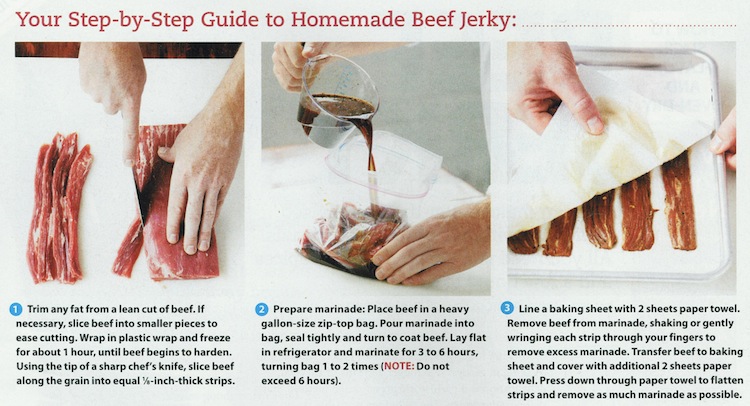
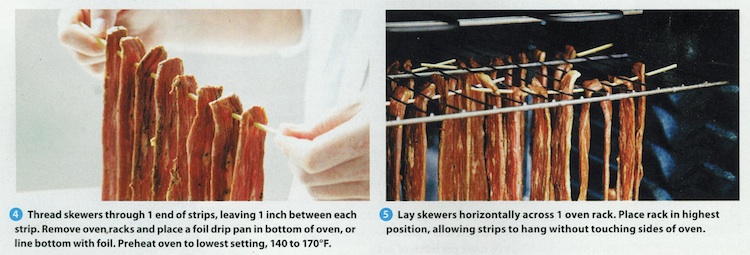
FOUR: Line a large baking sheet with 2 sheets paper towel. Remove beef from bag, shaking or gently wringing each strip to remove excess marinade. Transfer to baking sheet and cover with additional 2 sheets paper towel. Press down through towel to flatten strips and absorb as much marinade as possible. Remove oven racks and place a foil drip pan in bottom of oven, or line bottom with foil. Preheat oven to lowest setting, 140 to 170°F.
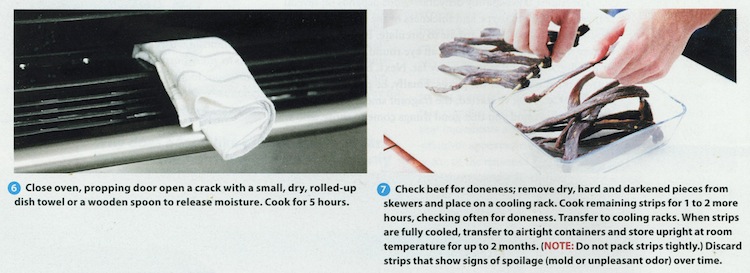
FIVE: Thread skewers through 1 end of strips, leaving 1 inch between each strip. Lay skewers horizontally across 1 oven rack. Transfer rack to highest position in oven, allowing strips to hang without touching oven walls. Close oven, propping door open a crack with a small, dry, rolled-up dish towel or a wooden spoon. (NOTE: This is necessary to allow moisture to escape from the oven; the oven temperature is low enough that this is not a fire danger.) Cook for 5 hours.
SIX: Check strips for doneness; remove dry, hard and darkened pieces from skewers and place on a cooling rack. Cook remaining strips for 1 to 2 hours, checking often for doneness. Transfer to cooling racks. When strips are fully cooled, transfer to airtight containers and store upright at room temperature for up to 2 months (NOTE: Do not pack strips tightly). Discard strips that show signs of spoilage (mold or unpleasant odor) over time.
SEVEN: Devour. Then, imagine limitless flavour possibilities. Next time we make this (which will be soon), we’re going to try a curry-spiced variety.
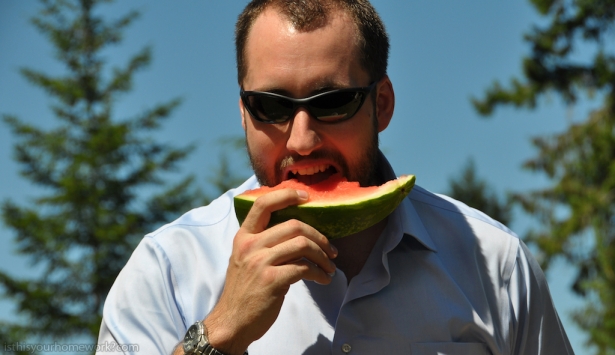
I remember when you could get both seedless and true watermelon. I remember trying the seedless version. It was but a pale shadow of the vibrantly red, beautifully sweet, and deliciously refreshing true seeded wonder-food.
A true watermelon was pure ambrosia for a child. Similar in colour and property to the high-octane hummingbird food which fuels their unbounded energy, a watermelon served as the perfect pit-stop for young racing machines. Whether participating at the Picnic Grand Prix, the Baseball 500, or the Beach Superspeedway, every nanosecond spent on pit-row eating or drinking meant that you were missing out on everything that was going on.
In this way, watermelon seemed as if it were purpose engineered to suit the needs of youth. Not only would it provide both requirements of life, sugar and liquid, but your last piece could be taken on the go, shaving precious moments off your down-time.

We were made for each other.
That your hands, face, chest, and right forearm from elbow toward wrist would be smeared with stickiness was inconsequential to a kid. It would be washed off by the next plunge, or covered up by a film of dirt, or perhaps neither. To paraphrase a line from Predator: “Ain’t got time to clean”. It’s not that a conscious decision was made by an elite commando to ignore his wound, nor does a kid intentionally ignore the slathering of gluey juice, rather it simply isn’t on the radar of ‘Things That Are Important Right Now’.
Of course, when that final wedge was finished, you were left with a rind of the perfect size and weight that needed to be hucked into the woods/lake/ocean or sometimes onto the roof. It was food after-all, so it wasn’t littering.

Never throw away a whole watermelon.
 Marc on
  Junior on
 Barbara Fuentes on
  Kathy on